
CP chemical pallet specification
CP5 pallet: 760 × 1140 mm
Narrow container-oriented loads where the 1140 × 760 footprint is specified.
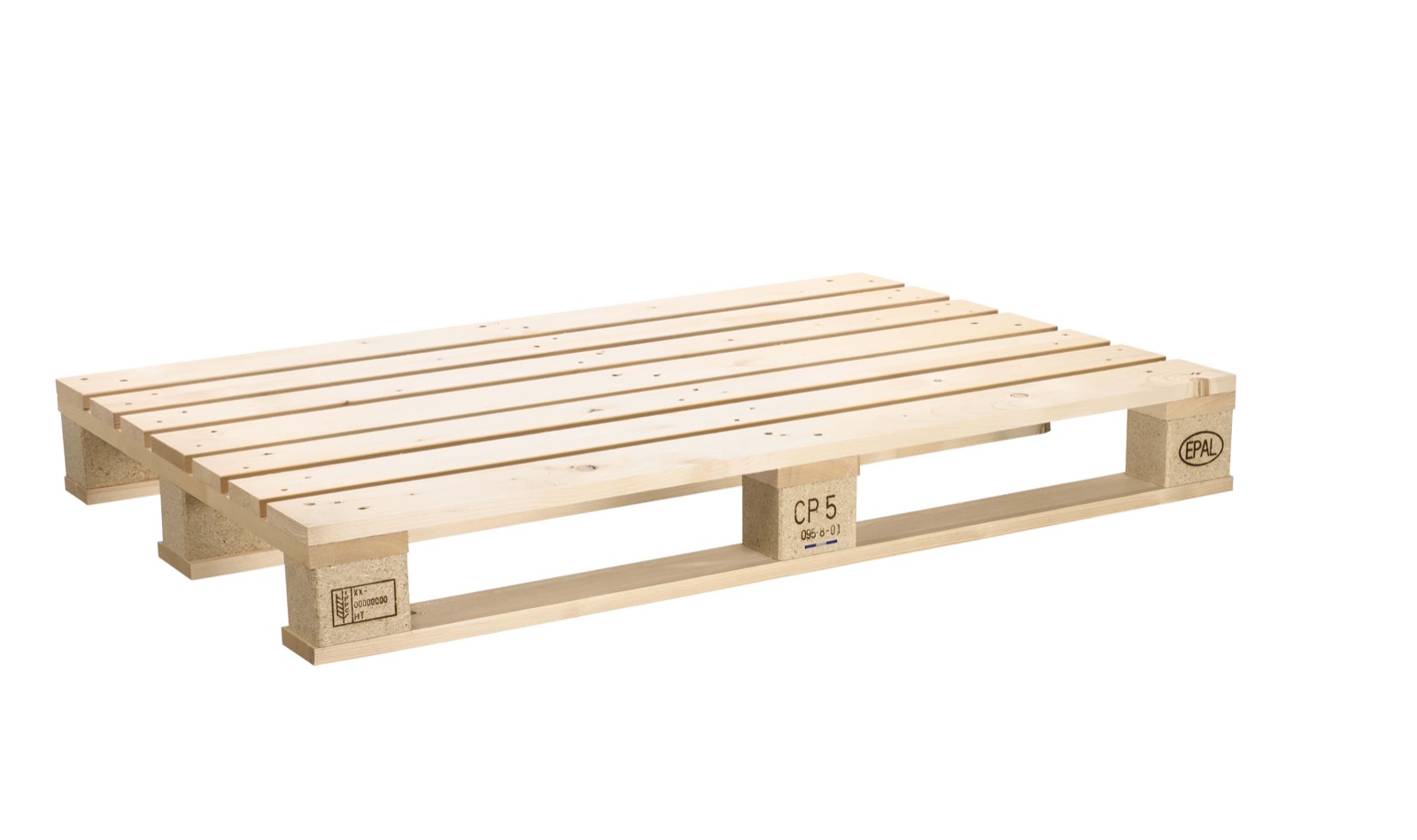
What is a CP5 pallet used for?
The CP5 is one member of the CP1–CP9 family developed for chemical-industry logistics. Its footprint and construction match particular containers and load patterns. It is normally specified because a customer's packing instruction, filling line, container or handling process requires this precise subtype—not simply because the load needs a wooden pallet.
Narrow container-oriented loads where the 1140 × 760 footprint is specified.
Typical load formats
- Cardboard boxes
- Crates
- Containerised packaged goods
These are recognised applications, not a promise that every load of that kind will be suitable. Product weight, load distribution, stacking, racking and handling method still need checking against the exact pallet offered.
Why choose CP5?
CP5 is noticeably narrower than the other CP formats. Measure both sides rather than identifying it from appearance alone.
If your paperwork says only “CP pallet”, send us the document or a photograph with a tape measure visible. We will help identify the subtype before pricing it.
New, used and export requirements
Availability varies by subtype and condition. Used CP stock is more restricted than common UK or Euro footprints, so planned recurring demand is easier to support than a last-minute substitution. Heat treatment and plant-health marking are separate from the CP number and depend on the destination and the actual pallet supplied. For goods leaving Great Britain, including to the EU, read ISPM15 explained and export pallets; for recurring or multi-site demand, see account supply, and how to write a pallet specification.
CP5 nominal specification
- Footprint
- 760 × 1140 mm
- Nominal height
- 138 mm
- Fork entry
- Four-way
- Base
- Three-runner base
- Deck
- Winged deck
- Condition
- New or used, subject to confirmation
Dimensions and construction identify the subtype. Tare weight, capacity, treatment, markings, condition and availability are confirmed against the exact pallet offered.
Have this ready for a CP5 quote
- Quantity and whether the order is one-off or recurring.
- A customer specification, drawing or clear photograph if available.
- What the pallet carries and the maximum loaded weight.
- How it is lifted, stacked, conveyed or racked.
- New or used condition and whether substitution is permitted.
- Destination, delivery postcode and required date.
What the load figures mean
- Tare weight
- The mass of the empty pallet itself, before anything is put on it. It matters for vehicle payload, air freight and weighbridge figures, not for how much the pallet can carry.
- Static load
- The maximum load the pallet is rated to hold while standing still on a solid, level surface — the pallet fully supported underneath.
- Dynamic load
- The maximum load the pallet is rated to carry while it is being handled or moved, for example on forks or a pallet truck.
- Racking load
- The maximum load the pallet is rated to hold while supported only at its edges or on beams. It often differs from static and dynamic capacity and applies only in the exact rack or support configuration stated by the manufacturer.
Ratings depend on the exact construction, how the load is distributed, how the pallet is supported, its condition and the manufacturer. A rating can never be inferred from footprint alone: two 1200 × 800 mm pallets can behave completely differently. No load or tare figures are published on this page, because there is no single authoritative value for this kind of pallet. Tell us what the pallet has to carry and how it will be supported, and we will confirm the capacity and tare weight against the exact stock we would supply.
Speak to a pallet specialist
Tell us the CP5 quantity, load, condition, destination and timing. We will confirm what is available and what still needs checking.