
Knowledge Centre — grades, sizes & procurement
Pallet sizes and dimensions: what a footprint tells you
Footprints are the shorthand of pallet procurement. They are useful, they are widely understood, and they are routinely asked to carry far more meaning than they can.
Published by Palletmove. Last reviewed: 3 September 2026. A reference for describing and measuring footprints, not a substitute for measuring your own stock. Nominal sizes vary in practice, and we don't quote construction, load or weight figures for stock we haven't assessed ourselves.
The two footprints you will meet most
1200 × 1000 and 1200 × 800
Almost every UK conversation starts with one of these two nominal footprints. What follows is what the footprint decides — and what it leaves entirely open.
| Nominal footprint | Where it is typically seen | What it still leaves open |
|---|---|---|
| 1200 × 1000mm | Widely used in UK domestic distribution and often called the 'UK standard' footprint. | Construction, entry, deck coverage, base arrangement, condition, treatment and load capability. |
| 1200 × 800mm | The Euro footprint, common on continental inbound stock and in mixed European flows. | Whether it is a genuine EPAL pallet, plus everything in the row above. |
| Half and quarter footprints | Retail display and lighter goods, usually to a customer's own requirement. | Everything — these are almost always defined by the receiving customer's spec. |
| Non-standard and bespoke | Engineering, plant, glass, drums and anything that does not fit a rectangle neatly. | Whether a standard footprint can be adapted at all, or a purpose-built pallet is needed. |
Length, width, and which is which
Convention in UK pallet description puts length first and width second, and the length is normally the side along which the stringers or bottom boards run. That convention is not universally applied, and "1000 × 1200" and "1200 × 1000" are frequently used to mean the same pallet by people who are not thinking about orientation at all.
This matters when entry is involved. If a pallet is four-way it may not matter which face is called the length. If it is two-way, and your trucks approach from the side that has no entry, the pallet is unusable in your operation even though it matched the order exactly.
Height is a specification too
Overall pallet height is often left out of requirements entirely, and then causes a problem at the first delivery into fixed-height racking, a trailer with a set number of tiers, or an automated system with a defined entry aperture. If your storage or transport is tier-limited, state the overall height and the acceptable tolerance.
Footprint does not imply treatment
No footprint carries any implication about plant-health treatment or marking. Whether a pallet needs an ISPM15 mark is decided by the route the goods take. It is established separately from size, and separately again from packaging regulation, which is a different regime altogether.
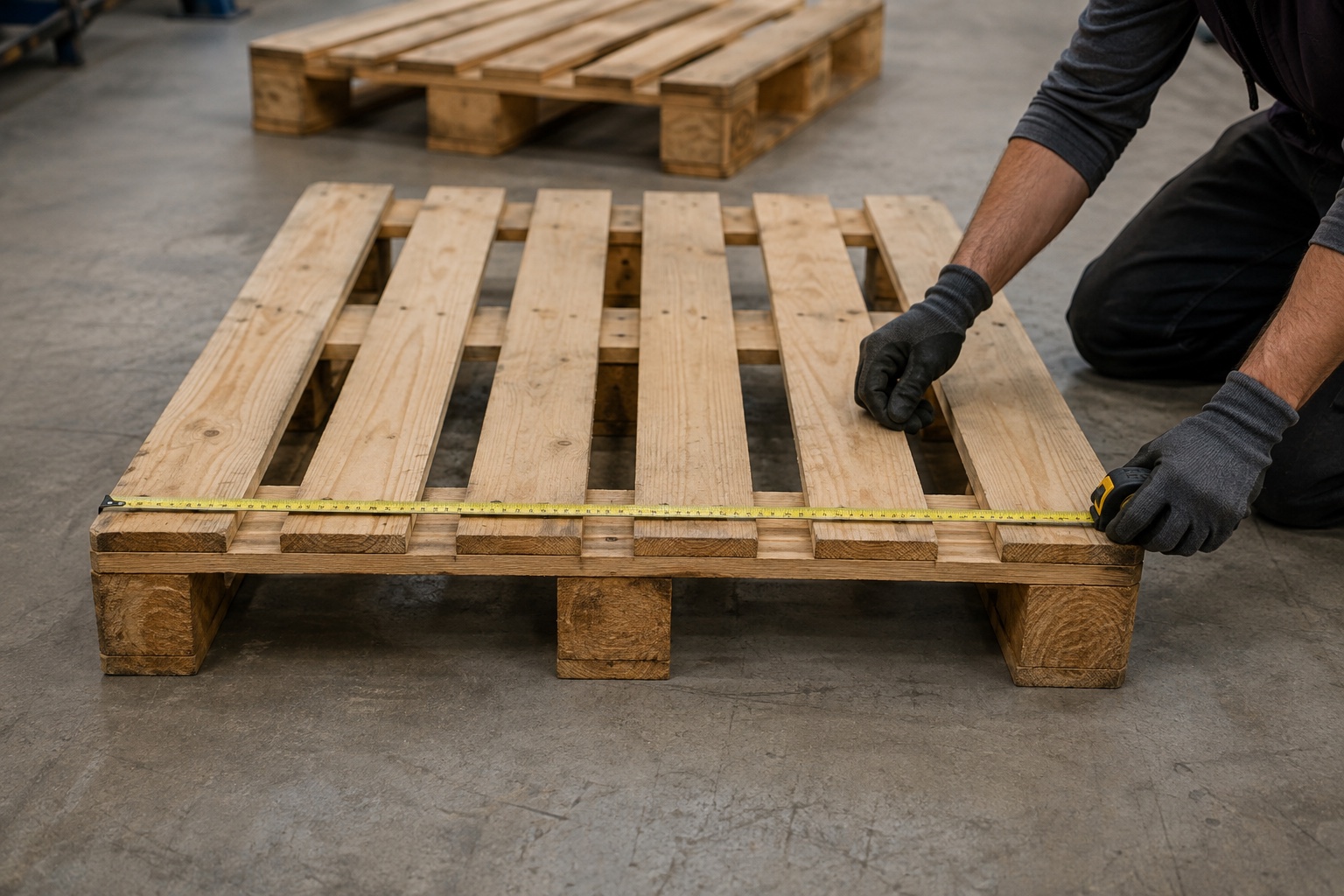
How to measure and record a sample
- Measure the deck at its widest point, in millimetres, on both axes.
- Measure overall height with the pallet on a flat floor.
- Photograph the top deck square-on, the underside, and one side elevation.
- Note whether entry is available on two sides or four.
- Note the base: full perimeter, three bearers, or open.
- Photograph any marks on blocks or side boards, close enough to read.
Continue
Apply this to a requirement
- UK 1200 × 1000 footprintWhat still has to be agreed beyond the footprint.
- 1200 × 800 footprint palletsThe Euro footprint, and why it is not automatically EPAL.
- Pallet specificationsThe five attributes of a usable specification.
- Pallet grades explainedWhy grade letters travel badly between suppliers.
- Business pallet supplyBulk and account supply of used pallets.
- Talk to PalletmoveSend photographs and measurements of a sample.
Not sure what you are actually receiving?
Send measurements and photographs of a sample pallet and we will describe it back to you in specification language.