
Knowledge Centre — reuse, recovery & reporting
Reducing pallet waste in warehouse operations
The cheapest pallet to recover is the one that never gets broken. Most sites can cut their end-of-life volume substantially without buying anything — by changing how pallets are specified, handled, stored and moved.
Published by Palletmove. Last reviewed: 3 September 2026. Practical guidance drawn from site practice — no modelled savings, percentages or benchmark figures, just what actually works.
Prevention before recovery
National waste policy puts prevention above everything that follows: keep goods and materials in circulation for as long as possible and at their highest value. For a warehouse operation that translates into a short list of unglamorous mechanics — the specification you buy to, the equipment that lifts it, the way it is stacked, and how long it sits outside.
The five causes we see most
Damage is rarely random. On most sites it clusters around a handful of repeatable causes, and each has a practical fix that costs less than the replacement stock it saves.
Accumulation is its own problem
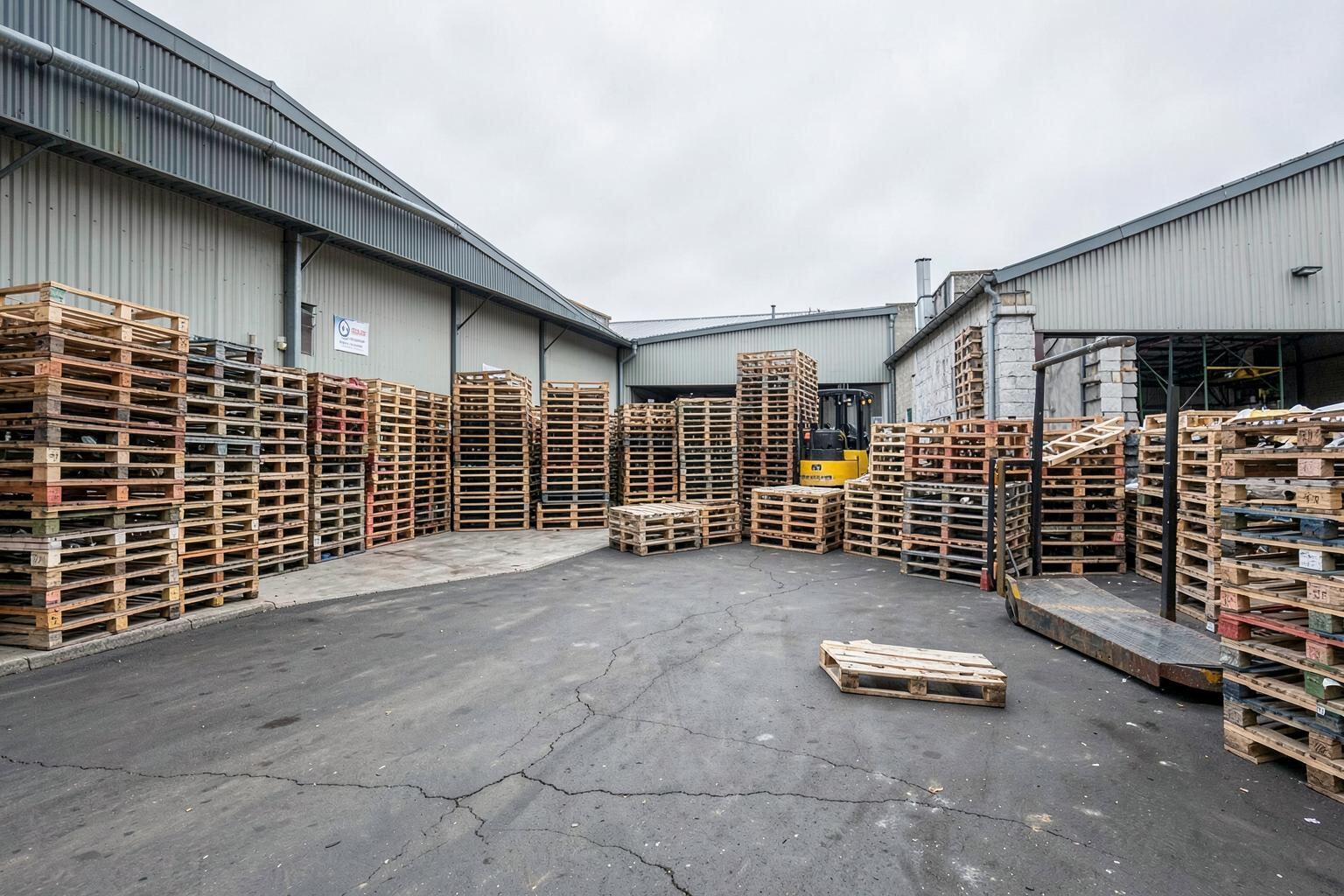
A pile that grows for six months does not hold its value for six months. Weather degrades timber, the bottom of the stack takes the load, and pooled operator stock quietly disappears into the middle of it. Regular scheduled collection preserves more value than an occasional big clearance, and it keeps the yard safer.
Causes and fixes
Where the damage comes from
| Cause | What it looks like | Practical fix |
|---|---|---|
| Wrong specification for the load | Consistent failure of the same component across many pallets. | Rewrite the specification around the actual load and handling method, including the failure mode. |
| Handling technique | Damage concentrated at fork entry points and outer bearers. | Targeted refresher briefing at the bays where the damage clusters. |
| Block stacking too high | Crushed bottom-layer pallets. | Set and enforce a stack height limit for each pallet type. |
| Outdoor storage | Weathering, water ingress, general timber degradation. | Cover where possible, and shorten the time between accumulation and collection. |
| Slow accumulation | A growing pile nobody owns, with mixed categories in it. | A scheduled collection rhythm and a named internal owner. |
A site review that actually finds something
- Walk the route a pallet takes from inbound to outbound and note where it is touched.
- Photograph the damage clusters — the same component failing repeatedly is a systems signal.
- Count what leaves the site by category over one month, not one day.
- Identify who owns the pallet pile. On most sites, nobody does.
- Check whether pooled operator stock is accumulating unnoticed.
- Compare the specification you buy against the load it actually carries.
Where Palletmove supports the review
- Assessing what is in the pile and what condition it is genuinely in.
- Separating reusable, repairable, end-of-life and pooled stock.
- Setting a collection frequency that matches your accumulation rate.
- Advising on the specification for replacement supply.
- Recording categories and volumes so improvement can be measured factually.
Next
Continue
- Pallet managementStructured pallet flow across one site or many.
- Reuse and recoveryHow the repair-or-recycle decision is made.
- Pallet specificationsSpecifying to the load and the failure mode.
- Pallet collectionA scheduled rhythm instead of occasional clearances.
- SustainabilityThe reuse-first approach in full.
- Talk to PalletmoveBook an operational review of your pallet flow.
Pile growing faster than anyone planned for?
A scheduled collection rhythm preserves more value than an annual clearance ever will.